The Navy still doesn’t understand what makes SWOs tick

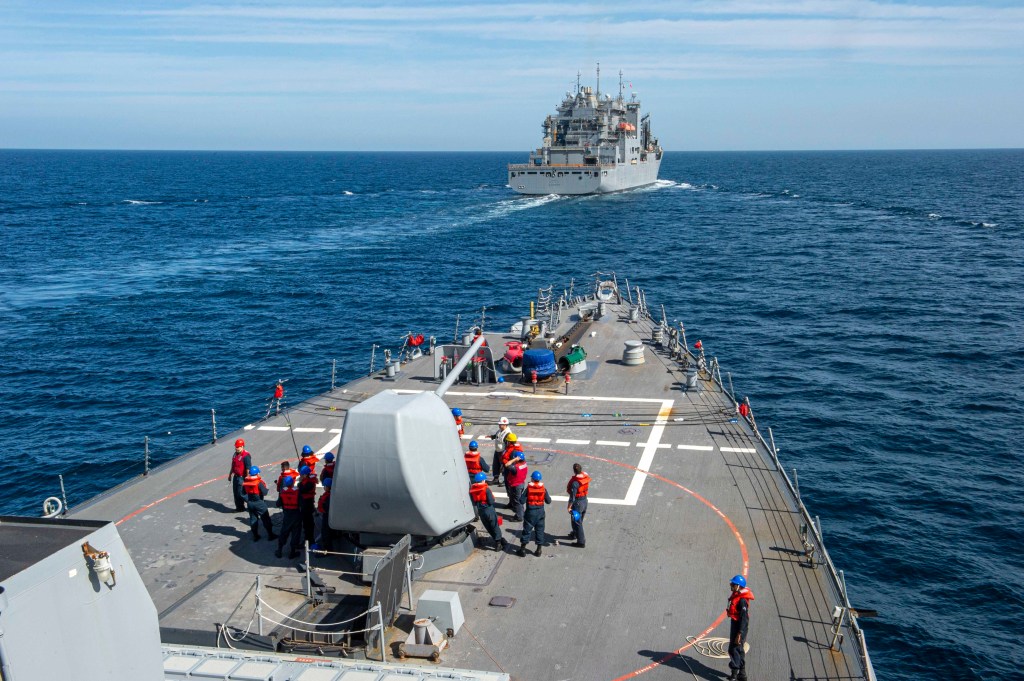
GULF OF OMAN (Feb. 20, 2023) The guided-missile destroyer USS Paul Hamilton (DDG 60) approaches the dry cargo and ammunition ship USNS Alan Shepard (T-AKE 3) in the Gulf of Oman, Feb. 20, 2023. Paul Hamilton is deployed to the U.S. 5th Fleet area of operations to help ensure maritime security and stability in the Middle East region. (U.S. Navy photo by Mass Communication Specialist 2nd Class Elliot Schaudt)

Surface Warfare Officers (SWOs) have been a part of the Navy since…always. Our Navy started out on surface ships, and surface warfare continues to be important, no matter what an Aviator, Submariner or SEAL will tell you. Yet increasingly I have to wonder, does the Navy understand why it is so hard to keep SWOs? You would think with hundreds of years of history this would be obvious, but given its latest actions, I’m not so sure, because the US Navy is facing a SWO manpower crisis, and is dealing with it in ways that simply won’t work.

Let’s go back to my original rules for Navy manpower. When times are good and we have too many Naval Officers, the Navy does the following:

  1. Kick people out for failing physical fitness tests, even if they are otherwise good Sailors
  2. Make it hard to get waivers for things like antidepressants and other medical issues
  3. Begin nicely asking older Naval Officers to retire to make space for younger officers
  4. Lower the number of Officer Candidate School admissions
  5. Reduce bonuses
  6. Make life increasingly difficult, so that more people naturally quit
  7. Conduct a Reduction In Force (RIF) and simply remove people

This is a pretty good strategy to reduce numbers, slowly ratcheting up the pressure to ensure we don’t have too many officers hanging around. Naturally, if we have too few officers, the Navy turns this around by:

  1. Not kicking people out for physical fitness test failures
  2. Waiving darn near everything, from age to non-violent felonies
  3. Asking people to pretty-please stay around a few more years
  4. Opening OCS and other admissions
  5. Raising bonuses
  6. Make life better for officers
  7. Reduce opportunities to leave early
  8. Op-Hold people

In the past, the Navy has done everything on the first list to bring down numbers. Now, they are doing…almost everything on the second list, but it’s not working, and it’s becoming glaringly obvious in the SWO community. If you listen to Admirals speak (and I don’t recommend that), you would think we’re doing OK on SWO retention. But a brief glance at the Health of the Force survey shows that disaster looms around the corner:

Future force structure increases outside the future year defense plan (FYDP) require DH billet increases, requiring increased retention. This compares unfavorably with a declining billet base across the FYDP as the Navy divests legacy platforms. Year groups 2015-18 require an average retention rate of at least 37.3%, exceeding the 10-year average. If fleet size projections remain accurate, Surface Warfare requires a retention rate of 44% in YGs 19-22 to meet future afloat DH requirements.

Health of the Force Survey

So we’re not making the retention rate we need now, and we have to increase this by 10 percentage points in the future, but retention is plummeting.

All the Manpower people in the Navy right now…

The Navy is already overlooking physical fitness failures, waiving medical conditions and opening up OCS admissions…which are now having a higher-than-expected failure rate. I would think most people would understand that lowering admission standards will likely lead to more failures in a difficult program, but apparently “most people” doesn’t include Navy HR.

So what to do next? Raise bonuses. And boy did they raise them.

NAVADMIN 045/23 discusses continuation bonuses for SWO Lieutenant Commanders (LCDRs). SWO leave after their first Navy tour at a fairly high rate, and it’s hard to persuade them to stay in long enough to promote to LCDR around their 8-9 year mark. So why not pay them $22K a year IF they stay in after promoting to LCDR? It’s certainly worth a shot.

NAVADMIN 046/23 establishes a payment schedule for SWO Department Head bonuses. If a SWO screens for Department Head and agrees to stay for two Department Head tours, they can get bonuses up to $105K in total over 6 years. Conveniently, that would put them right at the point of getting a continuation bonus as outlined previously.

Now, normally this would work. Throw enough money at people, and you can normally get them to stay. But it’s not going to do that, and the reason is hinted at in the Health of the Force Survey:

Improving retention requires a multi-pronged approach. First, community managers are allowing more individuals to lateral transfer and re-designate. This will divest end strength in year groups with smaller DH requirements, freeing inventory for future accessions. Second, several monetary and non-monetary efforts are underway to improve Surface Warfare retention. Surface Warfare Officers now have a career-long continuum of monetary incentives with the introduction of the SWO Senior Officer Retention Bonus (SWOSORB) in FY22. Third, the community offers improved education opportunities including: postgraduate education opportunities, tours with industry, and fleet-up options for increased geographic stability. Fourth, Surface Warfare recently modified the career path to incorporate multiple family planning opportunities for career-minded SWOs. Finally, SWO released the junior officer survey, senior officer survey, and junior officer exit survey to solicit retention feedback.

Health of the Force Survey

Two things stick out:

  1. Family Planning opportunities? I thought Navy was all about killing babies, or at least circumventing existing laws to do so? Guess that’s not so popular when retention is on the line?
  2. The Junior Officer Exit Survey results.

I’ve read the JO Exit Surveys. They’ve existed for years, and they say the same things over and over:

  • We don’t train people enough
  • The job is thankless and people treat JOs like dirt
  • JOs find Navy life is incompatible with having any outside life or family time

That’s every survey, ever. Pay doesn’t make the top three retention issues in almost any survey. In the past though, enough money would make people overlook how bad the job is. But when truck drivers make over $100K a year, or companies pay project managers $150K or more a year, that $105K spread out over 6 years starts to look really small. The Navy caps officer bonuses at $330K over a career. Civilian companies don’t. Pay isn’t going to fix this crisis.

The ONLY hope for retaining SWOs is to increase quality of life. This would mean closing the sea duty billet gap, addressing the shipyard maintenance problems, and make driving a warship fun again. These are all inside the Navy’s wheelhouse, but it seems increasingly incapable of taking these actions. I suspect that the top SWOs are looking down thinking “You young officers are pathetic, back in my day we worked 16 hour days on shore duty and we BEGGED FOR MORE!!!”
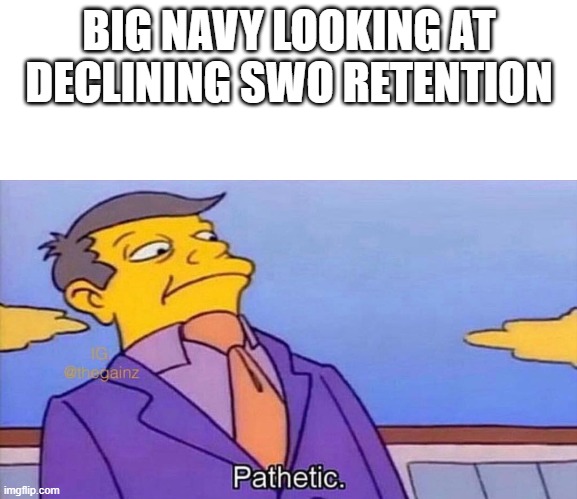
Given that pay won’t fix it, and Navy won’t address quality of life issues, I predict we get operational holds on people leaving in the next 6-12 months. I’d like to be wrong, and maybe next year you can repost this and laugh at me, but I have a bad feeling I’m right about this.

This post represents the views of the author and not those of the Department of Defense, Department of the Navy, or any other government agency. If you like this post, why not donate to DaTechGuy, or purchase one of the authors books?

The Navy’s Health of the Force survey says we are…

Unhealthy.

I know you wouldn’t guess it by the cover pictured above. If you didn’t see “NAVY” plastered in the center, you could be forgiven for thinking this was referring to firefighters or some other group of people. More on that point later…

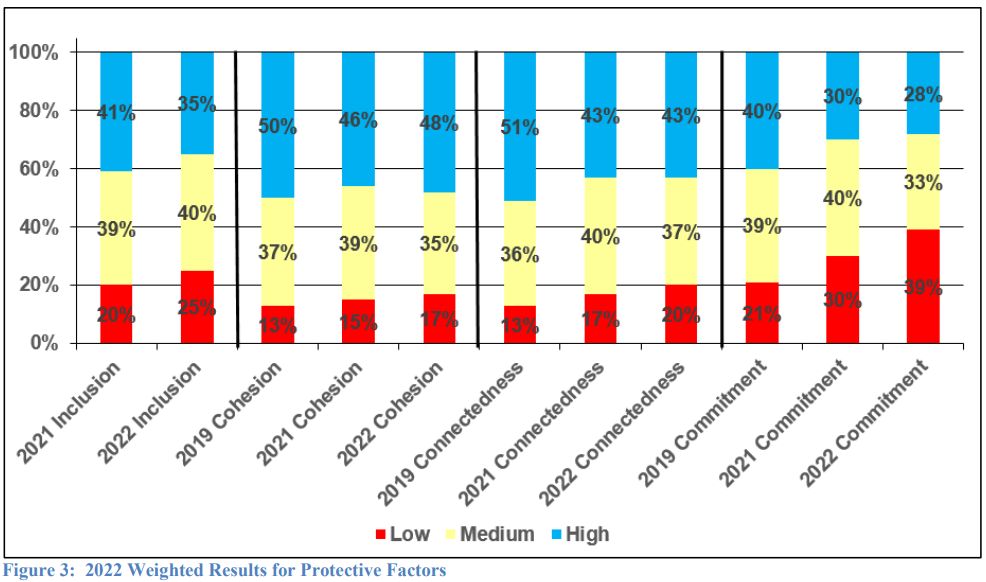
The Navy conducted a survey called the “Health of the Force” to gauge how well it was doing in the areas of Sailor retention, healthy behaviors, and other longevity areas that concern the “people” side of things. You can read the survey here. Full disclosure, I took this survey. If you’ve been following this blog for sometime, you can guess that the results of the survey reveal a Navy in trouble, especially in terms of recruiting, and well, the first major graphic of the survey sure seems to indicate just that.

Sailors increasingly think that the Navy isn’t committed to them? Even the surveyors agreed that “The negative trend for all four of these protective factors is statistically significant.” But wait, it gets worse. When Sailors were directly asked if they would stay in or get out of the Navy, we get these numbers…

Ouch.

In the course of five years, we went from over 60% of young men intending to stay to retirement to just under 40%. This is really bad considering that men make up about 80% of the Navy. Female retention is always difficult, because the Navy is not family friendly (no matter how often they lie to themselves about it), so women are often stuck between “Have a family” and “Have a Navy career.” Seems like many are increasingly picking the former.

So I wonder what happened in 2018 that caused this dip? The top reason people cited for staying in was “benefits.” Hmmm…didn’t we change the retirement in 2018? Didn’t someone blog about that and said it was a bad idea? Who could have seen that coming?

Nahh, I bet cutting retirement benefits had nothing to do with the young people deciding that the military wasn’t a good long term fit for them.

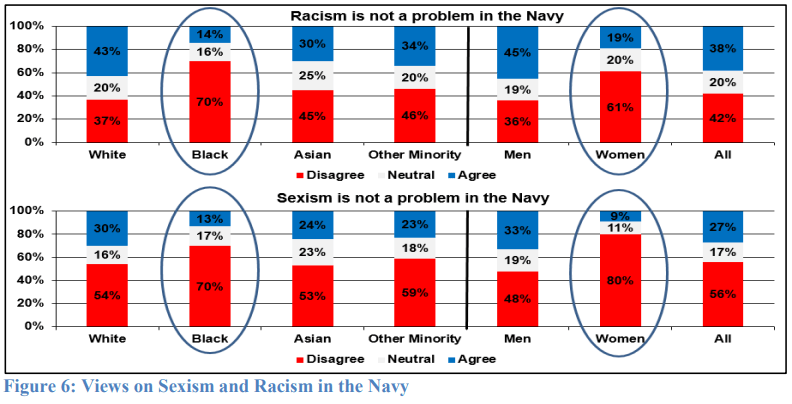
But at least we’re doing well in the DEI arena, with all our mandatory training, right?

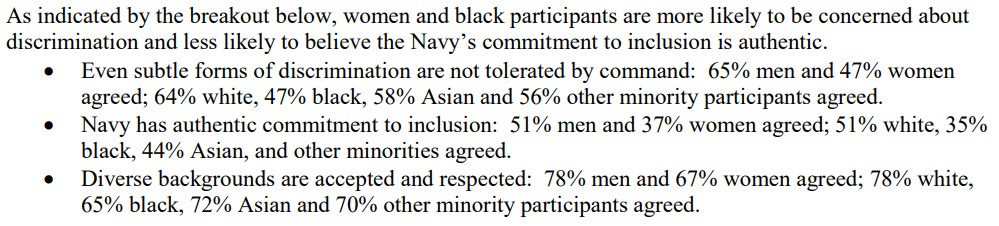
Ouch. Now, these graphs look bad, but I noticed an interesting paragraph above them:

I’m wondering how much of the high number in the graph an aggregate of many smaller numbers. Like, if sexism is a “problem” in the Navy, is it a big or small problem? Is it better now than before? The survey text and the graphs shows very different results, so I think too much is aggregated to get the finer details. The reality is though that for all the focus on racism and sexism training, we don’t seem to be getting better, or at least we aren’t perceived as any better.

Same goes for suicide. For all the money spent on prevention, its not making a difference. Normally people are fired for this, but instead we’ll keep pouring money down a drain while young people continue to kill themselves.

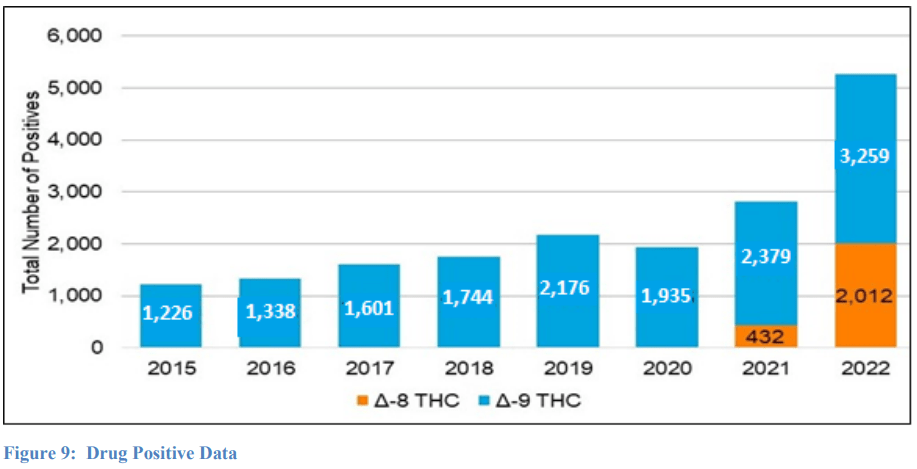
Apparently Navy Sailors like using drugs that aren’t just alcohol…who knew! The rise in cannabis use will impact recruiting in two ways. First, you’ll have to issue more marijuana waivers to get otherwise qualified people to join. Second, if anyone wants an easy ticket out of the Navy, they can just smoke a few joints and pop positive on a drug test.

Long time readers will remember when I predicted that to make numbers, Navy would turn off all the “early out” taps, extend contracts, lower standards and throw money at the problem? Well, this survey confirmed all of that. Here’s a section from the “enlisted retention” portion:

Remember when the Navy made headlines saying they “made their recruitment numbers!” this past year, and I said that was a prop to hide a big problem? Well, I was right. The Navy drained its DEP numbers (essentially a reserve of Sailors signed up but waiting for boot camp) to make that short term goal. Now future Sailors “are shipped to boot camp withing weeks or even days of contracting to serve.” See below.

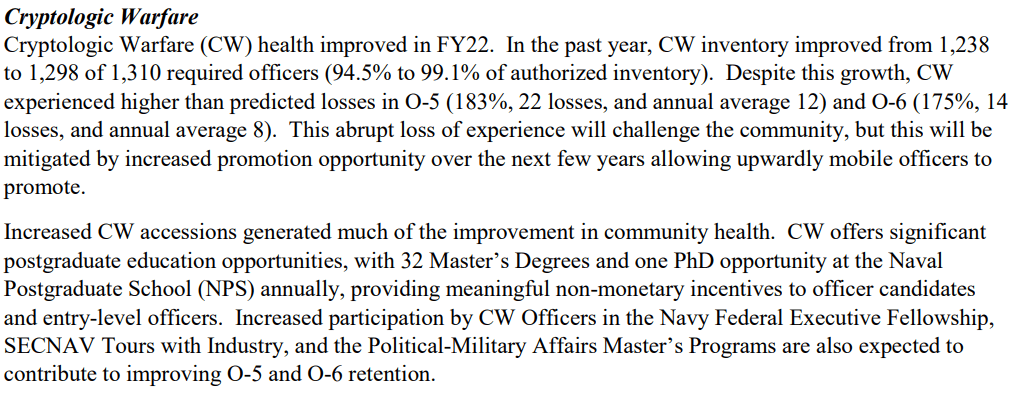
The officers are no better. Here’s a few snippets from various fields:

The last graphic sums it up the best.

If you can’t fully man, or overman, the billets that we have at sea, then you’re not doing your job. Has anyone been held accountable for this mess? It’s obviously been going on for a long time. Why was nobody fired?

Here’s the sad truth: Health of the Force told us that despite all the efforts of our “manpower heroes,” we still perceive ourselves as racist and sexist (and remember that perception doesn’t have to match reality), we emptied our coffers to keep people in, nobody wants to stay to retirement age, and we can’t man the most critical jobs we have.

It’s going to be a bad few years for the Navy until they figure themselves out.

This post represents the views of the author and not those of the Department of Defense, Department of the Navy, or any other government agency. If you liked this post, why not donate to DaTechGuy or purchase one of my books on Amazon?

Traditional Catholics and traditional terrorists

So I don’t know where to even start with this one. Obviously I’m referring to the FBI memo from the Richmond, VA office that indicates growing concern over terrorism people not worshiping the state in so-called “Traditional” Catholic parishes. When I first saw this article appear, I gave it the ole’ 72 hour wait to see what ends up being true.

After having the FBI confirm it, I went ahead and read the memo. I have read many, MANY FBI memos in the past. I’ve read plenty of intelligence memos from various agencies, and I’ve written a fair number of memos myself and with others. I also wrote a 100+ page masters thesis that was read by some very smart and important people in our government. I know that writing well is important because you never know how far something you write will travel, whether its an email, memo or 100 page analysis. Since its that important, you should learn to write well, cite good sources and be ready for criticism if you’re going to make points that are controversial.

Does this paper do that? Nope.

Seriously, go read it. First, it starts with an interesting statement: that RMVEs are interested in RTCs. As a network guy, I immediately confused RMVEs with NVME solid state hard drives and RTCs with the people that yell at you at boot camp. But no, RMVE is Racially and Ethnically Motivated Violent Extremist, and RTC is radical-traditionalist Catholic. OK, lots of acronyms, which tells me this is legitimately from a government agency right off the bat, because we know that government loves its acronyms.

Reading the first few paragraphs, its actually kind of bland. The memo states that the FBI is seeing an increase in RMVEs reaching out to RTCs, attending services and engaging more on social media, and that the RMVEs are trying to recruit RTCs. That’s not a crazy assertion. If all you see at more “radical” Catholic churches is women wearing veils and priests speaking out about the evils of homosexuality, and especially if that group of “radical” Catholics thinks the world is on fire because of sins like homosexuality, then yeah, it might seem like a great place to recruit people that would be OK bombing a gay nightclub.

But that’s where it all starts to break down. When I hear Racially Motivated Violence, I think people that hate black people, or white people, or Asians, or immigrants, or something like that. I suspect most people do too. But I have yet to see the Catholic church, including more traditional churches, argue that racism is good. There are lots of Catholic positions that homosexuality, transgenderism, abortion and sex outside of marriage are bad and causing problems in society. These same Catholics vote and protest against the governments attempts to impose these views on people, which is probably the more likely reason the FBI doesn’t like these people.

Saying that the Catholic Church, and more traditional Church followers, appeals to racist terrorism is even more dumb when you think of the extensive Catholic Church in Africa and the Caribbean that is full of…wait for it…black people! The Catholic Church, even the more traditional portions of it, represents people from all walks of life and all skin colors.

If the FBI memo said they that violent extremists were recruiting traditional Catholics to bomb abortion clinics and gay nightclubs, I might, MIGHT believe it. But that’s not what the memo says. It’s specifically about race and ethnicity, and it makes no sense whatsoever. Heck, even the Huffington Post argued that the Catholic Church lead the way to decriminalize mixed-racial marriage.

Probably should have cited that article over Salon…but I digress.

The next part is though: the FBI referencing “tripwire and source development.” I read that as:

  • Place snitches in churches
  • Develop a list of “trigger” words
  • Wrap up so-called “radical” priests when they say mean things
  • Threaten a “radical” churches tax-exempt status if they say mean things about the state

Sheesh, does this sound like the Tea Party? Or Waco, TX? Or Trump’s home in Florida? Or the dude that got thrown in jail over defending his kid in PA? If I’m drawing this conclusion, so are a lot of other people.

The analysis in the notes section does an OK job of breaking out SSPX vs FSSP vs Norvus Ordo. Honestly, style point here: put in a side-by-side comparison in the future. One nice graphic would make it a lot easier on the reader.

Further down, the memo admits it conducted no Analysis of Alternatives, fancy speak for “what other conclusions could we draw.” For an example, imagine a memo saying “War with China imminent in X years,” linking the increase in Chinese military activity to a desire to invade Taiwan. An alternative analysis might be that China is simply posturing to distract its population from domestic problems. Not having an alternative is another indication of sloppy detective and writing work on the part of the memo’s author.

The memo cites the Southern Poverty Law Center and a Salon article, which is what most conservative news agencies are jumping on. But the issues are deeper then that. There is no analysis of any of the RTCs, not even a basic open source analysis. The “Slaves of the Immaculate Heart of Mary,” a scary sounding organization, is a bunch of nuns at a monastery. I doubt that they receive tactical weapons training on their campus, but maybe I’m wrong. If so, that might make for a cool addition to Larry Correia’s Monster Hunter science fiction series. But even a cursory review online shows that most of the organizations aren’t engaging in anything resembling violence.

The most disturbing thing to me is that this memo was even created and published. I’m sure the FBI gets thousands of leads every year, most of which end up being garbage. This looks like someone created an extensive memo over a single, unreliable source that was likely one racist person trying to recruit people that attend a Latin Catholic church. How did the Richmond station supervisor not read this and think “This looks dumb?” How did he or she not tell the author “You’re gonna need at least another source before we bother publishing this.”? That would have been my first comment.

So the FBI allows a poorly written memo attempting to tie racially-motivated extremists to members of the Catholic Church that attend a Mass said in a foreign language. It’s poorly researched, poorly sourced, draws crazy conclusions without data, all in what seems a blatant attempt to connect “white supremacy” to the Church. Much like the “white supremacy” nonsense that was tied to the military early on, this is only going to build more distrust in the FBI while doing nothing to fight actual terrorists.

This post represents the views of the author and not those of the Department of Defense, Department of the Navy, Roman Catholic Church, or any other government agency.

Full of hot air

High Altitude Balloon at the Natl Air and Space Museum Washington DC 11/13/2017

Balloons are nothing new. When I was stationed in Pensacola, I saw pictures of Naval Astronauts that went up in high altitude balloons to help us determine the effects that altitude would have on the human body. This helped us prepare astronauts on future space missions to safely live for extended periods at that altitude. Hot air balloons were used in warfare as far back as the U.S. Civil War. Heck, last year the U.S. was testing out steerable balloons off the coasts of California and North Carolina. So when China floated balloons out last year in international waters, it wasn’t a big surprise.

Flying a balloon 12 miles off the coast is fine, and we’ve been (mostly) consistent in our approach to accepting international norms on airspace and territorial waters. That’s why we don’t ram the Russian intelligence vessels that park off the coast in the Atlantic…or shoot across their bow, or any other nonsense that the crusty drunk guy at the bar will tell you we should absolutely be doing to maintain our honor as a nation…or something like that.

Oddly specific, I know, but I’ve had more than a few of those conversations.

But flying it over U.S. airspace? That’s a whole new level of brazen. I would be quite happy if we shot it down or otherwise captured it.

Do I think China would start WW3 over it? Nope. China will launch its war on its own terms. Yes, they would absolutely protest and try to impose consequences, but it wouldn’t involve WW3.

Why is China doing this? Intelligence from a camera or other devices is going to be better the lower in altitude you are, and balloons are far lower than satellites. But I think it goes further than that. China thinks it can get away with this violation. It’s not dissimilar to the U.S. driving two aircraft strike groups through the Taiwan Straits in 1995 as a response to China’s military exercises near Taiwan. The difference here is we never sailed in Chinese waters, but the balloons are obviously over U.S. territory.

What should our response be? It should have been to fire warning shots at the balloon when it crossed into airspace, give it a chance to leave, and if not, take it down as safely as possible. Following that, I propose hosting Japanese, Korean, Australian, Canadian and Taiwanese military leaders to discuss combining air space pictures to prevent this in the future. Since we already share air space pictures with each country in some way, getting them into a NORAD-like agreement in response to Chinese airspace violation is the perfect tit-for-tat response that would show real consequences to China’s military and government while not punishing the average Chinese citizen that doesn’t get much say in the matter.

What will actually happen? Nothing. The balloons will float away and the media will bury this story, like they buried the balloon story from last year. Unless a balloon hits a plane (unlikely) or malfunctions (I mean, it IS made in China!), there won’t be consequences for this at all, which will just encourage this in the future.

UPDATE: Well this post didn’t age well…two hours after posting and one balloon is shot down. Nicely done.

This post reflects the views of the author and not those of the Department of Defense, Department of the Navy, or any other government agency.

If you’re rusting at the pier now when nobody is shooting at you…

You’re gonna have a bad time

Seriously.

Somehow I missed this lovely picture from the beginning of the new year:

US Navy Photograph

If that looks bad to you, its because it is. That is absolutely terrible rust. Rust is a fact of life on a metal ship in a salty ocean…

Except that’s not true. Or it certainly doesn’t have to be. The Navy would like you to think that its all about lazy Commanding Officers and deck plate Sailors, and if they’d just try they could find time between their mandated diversity training and extremism training to scrub the decks a bit more and eliminate this problem. Am I exaggerating? Nope. Go read it off the official “Get Real, Get Better” page. The opening says it all:

Get Real, Get Better is a call to action for every Navy leader to apply a set of Navy-proven leadership and problem solving best practices that empower our people to achieve exceptional performance.

From Navy announcement on 13 Oct 2022

That right there is the problem. The Navy is pretending that its “proven” leadership style still works. It doesn’t.

Think about it for just a minute. Does it make sense that any Commanding Officer of a Navy destroyer, or any other ship, wants a rusty ship? That doesn’t make a lick of sense. What makes more sense is that they get forced into the position of not having enough time or resources to stop the rust they have. When ships and crews get run into the ground doing routine operations, and shipyards are incapable of doing anything on time or on budget (and face no consequences for doing so), guess what? Something has to give.

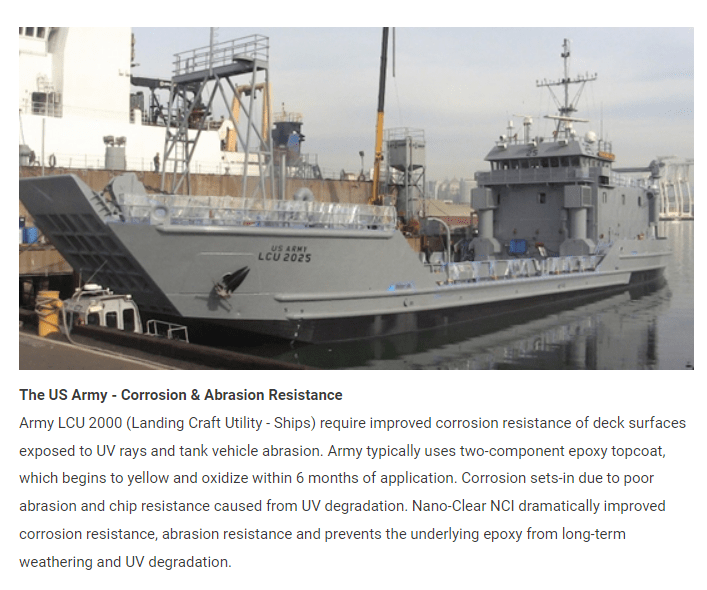
What might make sense is to use some technology to give Sailor’s time back. In industry, specialized coatings like Nano-Clear keep commercial vessels clear of rust for significantly longer periods of time. Heck, even the Army, which does operate some ships, uses them, as shown on Strategic Visionary Solutions’ website:

Nano-clear guarantees their product for 10 years. Even if the Navy got half of that, how many thousands of man-hours would be saved? How many Sailors would enjoy not using a needle gun to chisel of rust and paint?

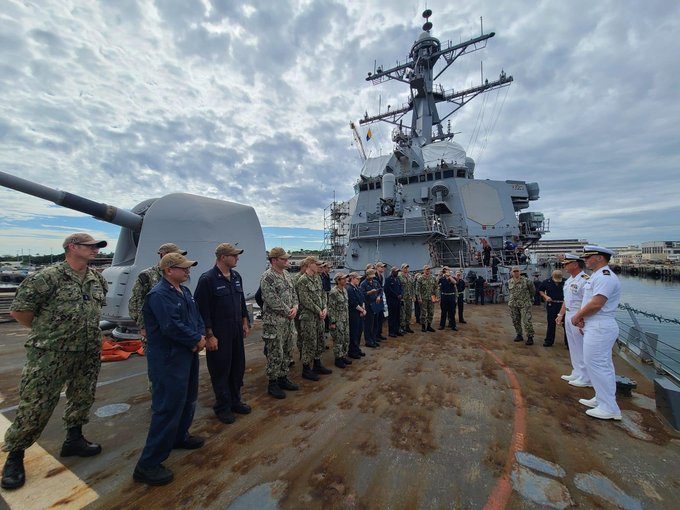
I mean seriously, does this look like what you joined the Navy for? From navy.mil

How does the Army get this and the Navy doesn’t? Are we surprised when people don’t want to join?

And then when we shame people into replying, we get this:

No acknowledgement of how hard the crew worked. Just a mild threat of holding them accountable.

And we’re surprised we’re in a recruiting crisis? Why?

This post represents the views of the author and not those of the Department of Defense, Department of the Navy, or any other government agency, because those people want to do more of the same and obviously the author does not.

ChatGPT says sue the schools!

If you haven’t heard of ChatGPT yet, or don’t know what it is…well, I’ll let ChatGPT tell you:

I am a computer program that can understand and respond to text in a way that’s similar to how a human would. Think of me like a robot that can have a conversation with you, but instead of talking, we write messages back and forth. My creators have taught me a lot of information and I can help answer questions and understand what people are saying.

So I asked it the following question:

There was a scandal announced recently where seven schools in the County of Fairfax, Virginia, purposely withheld the results of national merit scholarships from their students. This was likely a racist action by the school principals at those high schools, and probably hurt the affected students by denying them the opportunity for college scholarships. Can you write a 250 word blog post that describes what the parents of these students should do to seek justice for their students?

ChatGPT says…sue those bastards!!

The recent scandal involving the withholding of national merit scholarship results from students in seven Fairfax County, Virginia schools is a deeply troubling and unacceptable injustice. The alleged racist actions of the school principals involved in this scandal have likely hurt the affected students by denying them valuable opportunities for college scholarships.

As parents, it is important to take immediate action to seek justice for your students. The first step is to contact the school district and demand an investigation into the matter. The school district should be held accountable for the actions of its employees, and the parents should demand that those responsible be held accountable for their actions.

Additionally, parents should also reach out to local and state representatives and demand that they take action to address the issue. The state government should also conduct an investigation into the matter and hold those responsible accountable.

In addition to seeking justice through official channels, parents should also consider taking legal action against the school district and the individuals involved. A lawsuit can help to hold those responsible accountable and provide financial compensation for any harm caused to the students.

It is also important for parents to advocate for their children and ensure that they have access to the resources and opportunities that they need to succeed. This includes providing support for their children’s education and working to ensure that they have access to college scholarships and financial aid.

Finally, parents should continue to stay informed about the issue and advocate for change. This includes staying in touch with other parents and community members, and working together to make sure that such injustices never happen again.

In conclusion, the recent scandal in Fairfax County, Virginia, is a serious injustice that must be addressed. Parents of affected students should take immediate action to seek justice, including reaching out to school officials, representatives, and local authorities, and considering legal action. They should also support their children by providing resources and opportunities that they need to succeed. Together, we must work to hold those responsible accountable and ensure that such injustices never happen again.

Not bad for a computer that stopped processing information in 2021!

This post represents the views of the author and not those of the Department of Defense, Department of the Navy, or any other government agency.

Recruitment and the plague

Image from Wikipedia

When the Black Plague hit Europe in 1350, it ravaged the area and killed millions of people, especially in the lower classes. But afterwards, the labor shortage caused a working class revival in the peasantry. Day laborers could demand more money for their goods and better working conditions. From the Medievalists:

After the ravages of the Black Death were finished in Europe, however, there were suddenly far fewer people to farm the lands. Egyptian scholar Ahmad Ibn Alī al-Maqrīzī, described what this looked like after the plague had passed through Egypt: “When the harvest time came, there remained only a very small number of ploughmen.” There were some who “attempted to hire workers, promising them half of the crop, but they could not find anyone to help them.” The same was true in Europe, and crops remained unharvested and great revenues were lost for the local landowners because they couldn’t get anyone to do the work.

Egyptian scholar Ahmad Ibn Alī al-Maqrīzī

Not surprisingly, some people didn’t like these uppity peasants not knowing their place.

Many and various attempts were made by local governments and officials to block this upward movement. An Ordinance from Castile in 1351 condemns those who “wander about idle and do not want to work” as well as those “demand such great prices and salaries and wages.” It orders all able to do so to work for a set, pre-plague price. Another from Sienna condemns those who “extort and receive great sums and salaries for the daily labor that they do every day” and sets a fixed price of six gold florins a year. …
The English poet John Gower lamented in his Mirour de l’Omme that labourers who were used to eating bread made of corn now were able to eat that made of wheat and that those who had previously drunk water were now enjoying luxuries like milk and cheese. He also complained about their new, fancier attire, and their choice to dress above their station. His attitude was common among some in the upper and middle classes who lamented the social improvements of the lives of peasants and the loss of the good-old-days before the plague when the world was “well-ordered,” and people knew their place (as Gower says).

The Medievalists

The similarities to today are interesting. While the COVID-19 pandemic didn’t kill nearly the same number of people (especially in the US), it did lead to a massive revolt in the working class. Now truck drivers for Walmart make $100K a year, and there are plenty of people wanting these modern day versions of “peasants” to remain in there place (typically by using mass illegal immigration and inflation to suppress wages). The hardest hit by far is the military, because it relies on a large number of cheap, easy to enlist, (mostly) men to fill its ranks. While it is somewhat of a stereotype (as analyzed in 2020), its not entirely false either.

Stuck between rising prices, a loss of patriotism, an increasingly smaller subset of the population it can recruit, the military is now in the same personnel crunch as 1370’s landlords. It even has its own versions of complaints against uppity peasants, which I call the “appeal to patriotism” and “suck it up,” and are best explained in an example.

A few years back, I sat on a panel discussing the manning problems related to a specific set of submarine Sailors. Because serving on submarines is voluntary, we didn’t have a lot of Sailors in one particular rating, and we had to put an OPHOLD on a Sailor. An OPHOLD basically means we canceled that Sailors orders to another duty station and kept them in their current job. It’s supposed to be a rare thing, so the fact that we had to do this to meet minimum manning was concerning.

On the panel I suggested that we authorize a special bonus for these Sailors of around $150 a month. While that doesn’t seem like a lot of money, I had seen bonuses of that size bump up volunteers before, and I figured we could easily raise it again in the future if needed. I had at least two civilians, both retired master chiefs, scoff at this notion. “These kids should be volunteering for submarine duty out of patriotism!” one said (yup, literally his words). Another lamented that kids these days couldn’t “take it” when it came to the hardships of submarine duty.

The senior most officer (a Captain) asked why we couldn’t just keep OPHOLDing Sailors. Frustrated, at this point I jumped in and said “Your OPHOLD means nothing if Sailors start saying they’ll commit suicide, which guarantees you can’t assign them to a submarine.” The room got pretty quiet, and eventually the Captain agreed we should pursue a bonus. Ultimately the bonus did help and got us out of the manning jam, although it took a while and put the Navy in a pretty risky position at the time.

If you wonder why I’m never surprised at the horrible conditions onboard the GEORGE WASHINGTON and why Sailors commit suicide, well, now you know. Retired senior enlisted and officers sitting in cushy desk jobs that feel their funding might get cut if they provide more morsels to our young Sailors doing the hard work are all too common in our force today. Sadly, this class of bureaucrat is so deeply entrenched I’m not sure the military will survive before they can be uprooted.

This post represents the views of the author and not those of the Department of Defense, Department of the Navy, or any other government agency.

Navy FLOCs and Poverty Guidelines…not worth the paper they are written on

Don’t forget to read the previous two posts:

Part 1: Navy Community Outreach

Part 2: HYT+

To round out the last portion of NAVADMIN messages that tell us the Navy is in bad shape all around, let’s start with the Basic Needs Allowance. On initial reading, it doesn’t seem too bad. It basically says we’re going to pay Sailors that fall below 130% of the Federal Poverty Guidelines an additional amount of money:

2.  In line with reference (a), reference (b) established Department of Defense policy for BNA.  Reference (c) authorizes the Chief of Naval Personnel to implement BNA policy.  The BNA program provides a monthly allowance to Sailors whose gross household income (GHI) and household size place them below 130 percent of Federal Poverty Guidelines (FPG) for their permanent duty station (PDS) location.
BNA provides additional income to address the difference between GHI from the previous calendar year (CY) and 130 percent of the FPG for the current CY.  BNA is payable to eligible Sailors who voluntarily apply beginning on or 
after 23 December 2022.  These references, frequently asked questions, templates, and other BNA resources can be found here:  https://www.mynavyhr.navy.mil/References/Pay-Benefits/N130C/.

OK, so what IS the Federal Poverty Level? You can conveniently find them here:

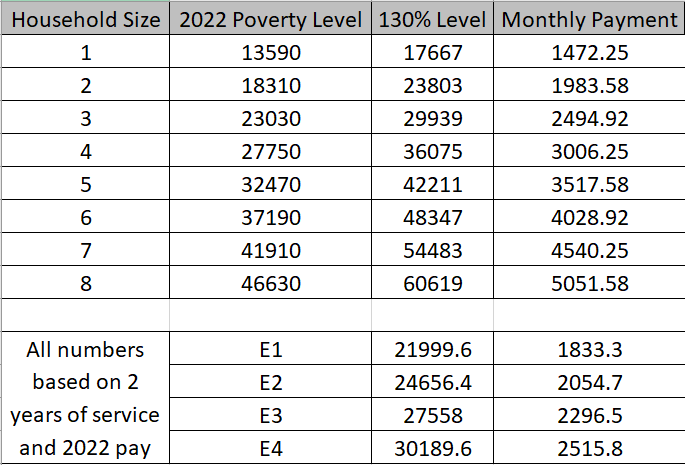
Now, if you’re thinking “That looks like a really, really small amount of money…” you’d be right. A little bit of Excel magic brings us some insight:

So, what do we learn from this? Well, if you’re a married E1 and your spouse doesn’t work, you might meet the threshold. If you’re an E2 or E3, married with a baby at home, you’ll probably meet the threshold. If you’re anything else…probably not. For this chart, I’m only counting basic pay, which means that if you got some sort of bonus that would count towards your income, you’re probably above the cap.

Here’s the other catch too….you don’t sit at those junior ranks for very long. Sailors can promote relatively quickly to E-5, which by 4 years of service is making over 3,000 a month. So unless you have three kids by then, you’re not meeting these guidelines.

At best, this is helping super new, dirt poor Sailors, who are likely living on the ship, eating at the galley for free and are unlikely to be married. But for the vast majority, this does nothing. Maybe in a week when they release the new federal poverty guidelines I’ll be proven wrong, but I don’t see this making a big impact. And given that advancement is getting easier with everyone leaving, that makes it even less likely to be impactful to the average Sailor.

Speaking of more things not worth the paper they are written on…NAVADMIN 290/22. This NAVADMIN offers a Flag Letter of Commendation for each person you sign up for the Navy. Sounds like a good deal right?

4.  In order to incentivize Sailors to assist in this effort, CNRC has authorized a Flag Letter of Commendation (FLOC) (max of 2) for any Sailor who provides a referral that ultimately leads to a future Sailor contract.  These 
FLOCs are worth one point each towards advancement and can make all the difference when final multiple scores are calculated.

Except…one point doesn’t normally do that much. Answering one more question correctly on your advancement exam, which probably requires less time then it takes to recruit someone, would be worth more. FLOCs are nice gestures, but they are relatively meaningless in terms of actual impact compared to actual awards. Worse still, they offer zero incentives to officers, so the Navy hasn’t done anything to stem that tide.

Where does this leave us? Honestly, in no better shape. While the Navy plans on a community outreach blitz to bring up its image, its not addressing many of the systemic problems inside its ranks, whether its low pay, unaccountable leadership, or a lack of strategic direction. People are smart enough to see through the shiny veneer and gift wrap, so these measures aren’t going to bump up Navy numbers.

Long term, unless the Navy gets a grip on how far its fallen and why people don’t trust it anymore, its not going to persuade people to join.

This post represents the views of the author and not those of the Department of Defense, Department of the Navy, or any other government agency.

Navy HYT+…mediocrity coming to a Navy near you!

Part two of a post from a week ago:

Post 1: Navy’s Community Outreach

I want to start by saying I don’t understand why everything is “+” now. We have Disney+, ESPN+, Daily Wire+…seriously? Is there some marketing guy driving around in a beat-up car telling everyone “You got to add a plus-sign at the end of your logo and then, THEN you make the BIG MONEY!”

Well, whomever that guy is, he must have talked to the Navy, because they rolled out High Year Tenure PLUS! Now, you might wonder, what the heck is High Year Tenure? In the military, the service only lets you stay a certain number of years at a particular rank. For example, if you’re an E-5 in the Navy (a Second-Class Petty Officer), you can normally only stay in for 16 years. At 16 years, if you don’t promote to E-6, you have to leave the Navy because you’re over High Year Tenure. Some military members call this the “up or out” program, which is probably the best simple description.

HYT has been around forever, and it gets changed over time. For example, HYT for E-4s used to be 20 years, so years ago you could theoretically do the same job in the same rank for 20 years, retire as a fairly junior member and get a small retirement. But over time, HYT bumped up so that members had to be at least an E-6 to get a 20 year retirement, and on the officer side at least an O-4.

Part of the point of HYT was to bring in new talent. The military relies on bringing in lots of young, talented individuals at the low end and then grows them over years into more senior leaders. HYT helps ensure that you either promote or leave, thereby opening holes for others to advance into. But when you can’t recruit, kicked out a ton of people over the COVID vaccine, and can’t draft people (at least not yet), then you have to resort to something else, in this case, HYT+!

Right out of the block, we get a contradiction: the first paragraph says HYT+ “offers a new opportunity for talented and experienced Sailors to continue their Navy careers beyond the HYT limits listed in reference (a). This pilot also offers additional looks for advancement and more time to build retirement benefits, to include E5 retirement.” Yet two paragraphs down, it essentially makes it mandatory:

b.  In order to facilitate this pilot program, all AC and TAR enlisted HYT dates occurring between 1 March 2023 and 30 September 2024 are hereby suspended, with the exception of CMDCM, CMDCS and nuclear trained master chiefs.  HYT Plus eligible AC and TAR Sailors with a HYT date in that time frame will no longer be involuntarily separated or involuntarily transferred to the fleet reserve due to reaching HYT as prescribed in reference (a).  The decision to remain on active duty beyond the normal end of active obligated service (EAOS) is voluntary and will not require the submission of a HYT waiver request.  Sailors who otherwise would have reached HYT between 1 March 2023 and 30 September 2024, but opt to transfer to the fleet reserve, or separate at their EAOS will be deemed a voluntary separation.

So….you get opted in by default? We assume everyone in the military is “talented and experienced?” Uhm…I call hogwash on that. We have a lot mediocre people that can’t promote because they are mediocre. But hey, let’s keep them around for numbers right?

What if you’re slated to retire? No problem! “HYT Plus eligible Sailors who are approved for HYT-based separation or retirement on or before 28 February 2023 may opt into the HYT Plus pilot any time prior to their separation or retirement date.”

We’ve seen suspensions of HYT like this before. When COVID impacted recruit training in 2020, the Navy allowed people to stay an additional year, even if they had an approved retirement. This worked because many companies weren’t hiring, so Sailors looking at a crappy job market got another year of pay and a guaranteed salary for their family. But that’s gone now. Any Sailor with skills will get snapped up in this incredibly competitive job market. The Navy already struggles to retain expert cyber expertise, and is at the point of recruiting people in the lowest percentile scoring on the ASVAB, the mandatory (at least for now) entrance exam into the military. Because nothing says “recruit more cyber people” like bringing in people that can barely write their name on the entrance exam!

So is this going to work? Not as intended. As my logo above indicates, it will keep mediocre people in that would normally struggle to find civilian employment because they don’t have competitive skill sets. Since you don’t have to promote and stay competitive, you’ll have more people doing just enough to get by, get to 20 years for a retirement….oh wait, we got rid of that, so people will simply leave anyway, typically when they have the skills needed (paid by Uncle Sam) to find a better job. Worse still, when you fill up with mediocrity, it pushes out those that want challenging assignments or want to push the envelope. We’re going to have less Mavericks in the service, since they get frustrated with the system and leave for companies that place more value on that skillset.

In short, HYT+ is going to drive the military to mediocrity. Rather than actually assess why people aren’t joining and fixing those systemic issues, the military is using a full bag of internal tricks to try and stay out of hot water. But its not solving the problem. It’s the equivalent of stopping a brush fire while the forest burns in the background. You might get a small improvement in the short run, but the big systemic problem is going to crush you in 2023-2024, just like I predicted years ago.

So, good luck with HYT+! Maybe it’ll be better than Disney+ in the New Year!

This post represents the views of the author and not those of the Department of Defense, Department of the Navy, or any other government agency.

Navy Community Outreach for 2023…fail or success?

First, Merry Christmas everyone! I’m writing this early in the morning while the family is sleeping on vacation. I hope all you wonderful readers are enjoying some much needed time off with your families!

I was going to write something fun and positive, but you know, the Navy had to go and release a whole bunch of juicy NAVADMINs that just show how desperate it truly is to retain talent, and in a few cases, how it very much is not acknowledging the reasons it is losing that talent. Remember in my previous posts how I said we’ll see a lowering of standards to bring people in, more monetary incentives to stay and eventually a total relaxing of rules on getting out, followed by forcing people to stay? Well, we’re probably almost at the forcing part. I have one aviator friend that had his retirement denied because the Coast Guard (not the Navy, but facing the same issues as the Navy) simply couldn’t afford to let him go. Thankfully he’s approved now for 2023, but he learned the definition of “orders” real fast. He won’t be the last.

Big Navy has accepted that 2023 is going to suck, bigly, and is pulling out all the stops to bring in enlisted talent. This week we got not one, or two, or even three NAVADMINs, but FOUR NAVADMINs related to retention in some way.

NAVADMIN 287/22 – NAVY COMMUNITY OUTREACH PLAN

NAVADMIN 288/22 – HIGH YEAR TENURE PLUS PILOT

NAVADMIN 289/22 – BASIC NEEDS ALLOWANCE

NAVADMIN 290/22 – EVERY SAILOR IS A RECRUITER

I’m going to break this into multiple posts, so we’re only focused on 287/22 for this post. Since none of these address officer retention, we’ll stay focused on our enlisted Sailors.

As background, for any organization, people come and go for a variety of reasons, but the ease of recruiting talent boils down to a few key things:

  1. Do you pay well?
  2. Do people believe in your mission?
  3. Do people believe in your leadership?

If you get those three things right, for the most part, you can compete for talent. The Navy doesn’t do any of these very well at this moment. Enlisted pay and benefits were always low, made worse by changes to the Basic Housing Allowance and retirement made years ago. While the Navy has a really important mission, it did a terrible job emphasizing this during the Iraq/Afghanistan years, and thus it absorbed part of the blame when we pulled out surrendered to the Taliban. In terms of leadership, well, it tends to be focused on making annual uniform changes rather than producing ships, submarines and aircraft on-time and on-budget that can fight our nations wars. Heck, it took Elon Musk to bring down the cost of satellite launches such that we have even a small chance of regaining our space dominance. It’s too bad he’s not in ship building, because we desperately need someone with his business expertise in that particular area.

With that in mind, let’s look at the long NAVADMIN about Community Outreach. I’m not kidding about long, its wordy even for me. It starts off with the normal fluffy garbage that all these messages tend to use, but then in section three it gets pretty blunt, pretty fast:

  1. Data
    a. Today, 26 percent of Americans consider the Navy as the most important service to our country’s national security, trailing only the Air Force’s 27 percent. This is a 14 percent increase since 2009 and a 1 percent increase from 2021.
    b. While the Navy continues to be viewed very favorably by the public, each of the services have experienced at least a 10 percent decrease in favorability during the past six years. In 2016, 82 percent of the country viewed the Navy favorably. Today, that number is 70 percent.
    c. In 2011, 57 percent of Americans said they would recommend joining the Navy. Today, 43 percent say they would.
    d. Three quarters of U.S. adults under 25 say they are not interested at all in joining any branch of the military.
    e. The percentage of Americans between the ages of 16 and 21 who say they will either definitely or probably join the military has fallen to 9 percent. The lowest point since 2007.

I mean, dang. That’s like the beginning to the movie Up! level of smack-you-in-the-face. To which I say “Damn right!” You have to start by acknowledging the problem you have.

Unfortunately, we get it wrong almost immediately in section five:

  1. Objectives
    a. Ensure 50 percent of all in-person community outreach engagements focus on 13-29 year-olds and 50 percent of all engagements within this age group focus on 13-29 year-old women.
    b. Increase the number of women under 30 who view the Navy favorably from 46 percent to 49 percent.
    c. Increase the number of African Americans who view the Navy as most important to national security from 17 percent to 24 percent.
    d. Increase the number of Hispanic Americans who view the Navy as the most important to national security from 24 percent to 28 percent.
    e. Increase the number of Americans over 25 who recommend joining the Navy from 43 percent to 48 percent.
    f. Increase the number of Americans under 25 who are considering joining the Navy from 12 percent to 15 percent.

Quotas anyone? Listing women and minorities right at the top isn’t a good look. You could have hidden that away, or at least said something like “We are America’s Navy, and we will increase all American’s trust in our Navy. We will also work particularly closely with some communities, such as African Americans, that have a markedly lower trust in our Navy than the average population.”

Sheesh, maybe I should sit on these HR boards…wait, never mind.

The rest of the NAVADMIN lists a TON of programs, and I can’t do it justice with a summary, so I’ll list them here with a grade for effectiveness.

Fleet Weeks – A
Navy Weeks – B+
Media Production Visits – C-
Sailor recognition – B
Naval Aviation Outreach – A
Continental Port Visits – A
Executive Engagement – F
Namesake Visits – A
Navy Band Tours – B
Social Media – B-
Entertainment – A
NCAs – C

Fleet Weeks and Aviation Outreach is a solid A. Naval aviation does a great job making it look cool, and there are enough pilots of every color and gender that it has a pretty broad appeal no matter what. This is bolstered by good ties with the entertainment industry, so more Netflix and History Channel shows on Naval Aviation is just going to help recruitment efforts.

It’s good to see Continental Port visits on there, and we need to do MORE of these. Fleet Week is nice, but it is simply too big for most cities to handle. Destroyers, frigates and even landing craft can pull into smaller ports, and should be doing that on a near constant basis. Not only does it promote spending more time underway practicing basic seamanship, but the small towns tend to come out in droves to support Sailors. The best receptions I ever get are from small towns that normally don’t see Sailors in uniform, and I think the Navy should budget more time for these on a permanent basis.

The namesake visits are long overdue. We name vessels after states, cities, Naval heroes and corrupt politicians, but it seems only the last one ever makes the news. I’d be all about naming vessels, especially the new frigates, after cities with higher-than-normal Navy Sailors. Often times the namesake visits happen but are very underreported, so advertising them better would be nice.

The choice of cities for Navy Week is…interesting? Using Wikipedia to see gross demographic data, some of the choices are obvious. Others, like Tri-Cities, TN (which I didn’t know was a thing until now, sorry Tennessee!) don’t make much sense. Maybe the under-25 population is higher there? That would explain Lincoln, NE, a traditional college town. More importantly, why not Detroit, MI, or other cities the rust belt? I’m guessing some of it may relate to availability, since if the city doesn’t let you come in, you’re just going to look elsewhere.

Overall White/Black/Hispanic percentages

Miami, FL: 11/16/72
Tucson, AZ: 43/5/42
Shreveport, LA: 35/55/4
Tri-Cities, TN: 96/2/1
Wilmington, NC: 71/18/8
St. Louis, MO: 43/43/5
Oklahoma City, OK: 49/14/21
Milwaukee, WI: 32/38/20
Billings, MT: 90/1/1
Lincoln, NE: 85/4/7
Cleveland, OH: 32/47/13
Salt Lake City, UT: 63/3/21
Salem, OR: 79/1/20
Philadelphia, PA: 34/38/15
Indianapolis, IN: 50/27/13

Same goes for Navy Band tours. Canada? Puerto Rico? At least we had some band performances at Navy Weeks. I’ve already written about Navy’s Social Media, and I stand by my assessment that its not bad, but not great.

Navy recognition has been very, very underused, and often the only calls are “quota based.” I saw one recently asking specifically for stories about female Naval officer achievements. Uhm…OK? At a previous command, I regularly sent my Sailors awards (with their permission) to their hometown news program. That actually motivated many Sailors to stay in, since many small towns held them up on a big pedestal when they visited during the holidays. It’s good to see it expanded, but I don’t see command’s doing much with it.

Media production visits and NCAs gets a solid C from me. I’ve never heard of NCAs before, and reading more about it makes it sound like a lobbying agency. That’s fine, but its not going to inspire young people to think highly of the Navy. Same goes with more boring media about the “importance of the Ohio replacement program.” No young person is inspire by the “Ohio replacement program.” It’s lammmme. Call it the “Punch Putin into the Stone Age” submarine. Again, this is more lobbying, and more appropriate for a different NAVADMIN.

Executive engagement gets a solid F. Our Navy Executives have done a dismal job at…everything. They can’t build ships or submarines on time or on schedule. That can’t get Congress to build more shipyards. They can’t hold their own accountable when they violate the UCMJ. They make excuses for why the Navy has abysmal infrastructure that literally kills Sailors. To top it off, they then typically roll into jobs to work on the same programs they mismanaged in the first place.

Nobody is inspired by these people. The best thing they could do is simply retire and stay out of the way of more capable people. Authorizing more flag officer travel isn’t going to solve our community outreach issues.

I’d give this NAVADMIN a solid “B+”. It’s got some really good ideas, and it finally spells out in clear language many of the issues the Navy has. But it then delves into quotas and lobbying that won’t do anything, and I worry that the Navy will focus on authorizing more flag travel instead of authorizing more small port visits. Execution is key, so we’ll see how it plays out this coming year.

This post represents the views of the author and not those of the Department of Defense, Department of the Navy, or any other government agency.